









Conducting Preparatory Course for ASNT NDT Level III (Methods: NDT BASIC, RT, UT, UT, PT, MT, LT, ET, NR, AE etc.) as per the SNT-TC-1A (2006) of ASNT syllabus and Examinations. Providing extensive ASNT NDT Level III Study Material (which includes Study Guide, Formula Booklet, Model Question Bank (QB) with Answers and Solutions for the Problem-Oriented Questions of QB) for the course.
The Study Material is alone provided (if the Customer is not able to attend the Course) as per the needs of the customers. Model Question Bank with Answers, Solutions for the Problem-Oriented Questions of QB and Formulae Booklet are also alone provided to the customers as per the needs.
IMTE Quality Engineers (P) Ltd. is organizing AWS-CWI courses in Faridabad (Haryana). With practical training and practice exams offered during the training, attendees can be confident of receiving the most specialized preparation needed to expand their knowledge base, improve their inspection skills and work with diverse fabrication, inspection & testing codes, standards & specifications industry wide. Our approach to education and training will provide an intense week of preparation that will not be found anywhere else. Seminars and materials are provided in various languages to facilitate attendees' needs.
If every employee or contractor hired came with an objective stamp of approval, we would never need to worry about deploying someone under qualified again. By specifying personnel who are AWS-certified, you:
Successful exam candidates become AWS certified welding inspectors, joining an elite group that share a worldwide defined level of proficiency. CWI's are entered into the AWS national register of CWI's, receive a wallet card, certificate suitable for framing, and a unique stamp for identification.
They are also listed in the AWS inspection trends magazine for industry reference and verification. These days, it takes more than just experience to be successful. It takes proof ! Proof of your worth and your ability. With AWS certification, you will never worry about losing your
competitive edge, since proof of active practice or re-examination is required at the time of renewal or re-certification.You will join thousands of welding inspectors who have gone through the program for over 25 years. The AWS certified welding inspector programme is designed for welders, inspectors, technicians and engineers.
Advantages / disadvantages of starters | Auto Transformer | Cable arrangement for Transformers & Motors | Cable Tray | Cables & Accessories | Cathodic Protection | CGP | Co-Gen. CPP | Control room light arrangement | DG, STG,GTG | Earthing room arrangement of equipment in control room | Electric Heat Tracing system | Electrical & Instrumentation interface | Electrical Earthing | General Light arrangement for commercial , House wiring , Industrial , plant | HVDC & EHVAC | |Int. Substation Building | Interconnected power systems , AC UPS / operation , DC battery charger/ operation , Various | Generators | Introduction Control Room Building , electrical equipment , fire alarm system , Substation equipment , system study , V V F Drives and applications , Relay & Types , lighting arrestor & there types , | electrical traction | Joints, Cable glands & Lungs | Lighting fixture | Mech. Design of over headlines & insulator | non-conventional generation | Operation & Control of interconnected power system. | Power system basics | Power system tariff | Protection of Buss Bar & lines | Public Address and Telephone systems | Single Line diagram for distribution system | street lighting | Synchronous & Usychronous motors | Transformer and bus ducts | Type of CT & PT switch in switch gears , Cables | Types of Circuit Breaker , Detectors , switch gears , starters | Various Protection of Generators , protection of Transformer ,Type of batteries , Generating plants | and Excitation systems , speed governing system.
The Certified Quality Inspector is an inspector who, in support of and under the direction of quality engineers, supervisors, or technicians, can use the proven techniques included in the body of knowledge. Under professional direction, the Quality Inspector evaluates hardware documentation, performs laboratory procedures, inspects products, measures process performance, records data and prepares formal reports.
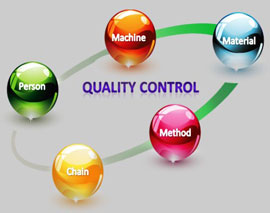
Quality Control (QC) ensures that products and services are designed and produced to meet or exceed customer expectations. "Quality Control" is a course that introduces the basics for understanding, developing, and implementing a quality control program. We review several key definitions, tools used(basic statistics and graphs), and emerging industry techniques.
After completing Quality Control, students will be equipped with a basic understanding of the following:
Process Engineering (Basic) is the First Stage in various fields of engineering. A process engineer plays an important role form “concept to Commissioning” in all sectors of process and related industries. With increasing emphasis on research and development new technology, new product and global competition, the requirements of skilled process engineers is increasing day by day.
A process Engineer has to be conversant with subject such as Fluid Handling, Unit Operation and reaction kinetics Nuclear and Thermal power stations Material of Construction, Field Instrumentation, Statutory and Safety aspects. MIT is the first institute in India to commence this course to meet the global challenges in basic engineering. MIT has proven its expertise in skill development program for Process engineers.
Today this industrially accepted course, India’s first ever in Process engineering, will become pioneer in education and training in all aspects of Process design and stands ready to meet their needs.
There are ample of opportunities for process engineering in various sectors of Chemical, Petrochemical, Energy industries. The process engineering constitutes over 25% of total Engineering man-hours in various industries like Chemical Process Industry, Oil & Gas sector and Thermal Power Plant. The prominent application sectors/industries for Process Engineering are Manufacturing, Process Engineering Licensers/Consultancy, Research and Development Organizations, Atomic and Nuclear power stations and Project Engineering firms.
The manufacturing industries include Chemical and Petrochemical Plants, Pharmaceutical Industry, Agrochemical Industry, Food & Beverages, Cosmetic Industry, Biotechnology, Mineral Processing and CNG/LPG Plants etc.
A process engineer plays major role at every stage of Process Engineering. Traditionally Process Engineers have been contributing in various industries. A process engineer has to be conversant with subject such as Fluid Handling, Unit operation, Material of Construction, Field Instrumentation, Statutory & safety aspects. The Pre–requisite skills for a Process engineer comprise Design, Manufacturing, Project Planning, Corrosion control system Metallurgical consulting, Facility audits, Automation & Control Systems, Security / commission of small & large scale process industry.
This course is designed for students who may eventually wish to specialise in structural engineering - as manifested, for example, in bridges and large buildings.
Later course years place emphasis on structural theory and design using different materials. The course introduces you to the effects of large loads, such as those due to earthquakes, wind and fire.
Although emphasising aspects of structural engineering, the core course units cover the same subjects as the civil engineering degree, thus satisfying the academic requirements for entry to both the Institution of Civil Engineers and the Institution of Structural Engineers. The first two years of the course are, therefore, the same as the MEng in Civil Engineering.
In the third and fourth years, you undertake numerically demanding research and design exercises relating to a wide-range of structures. The expertise gained from these exercises can be supplemented by the careful selection of design and research projects and by the choice of options that complement the work further.
MEng Civil and Structural Engineering provides you with a basic preparation for professional careers in the built environment sector (including design, construction, local authority and specialist work), as well as in other areas such as project management and finance.
We aim to instill not just knowledge of engineering science, but also a base of practical skills, an understanding of design, comprehension of the commercial world and competence in transferable skills (problem solving, team working, creativity, communications and IT).
Inspection of coatings (over fifteen types) applied in both the factory and field are addressed. The 5 day course is suitable for all candidates.
Piping study often referred as ‘half science & half art’. Art part includes visualization and creativity, while Science part includes following certain established norms. And both these parts involve lot of dedication, risk taking ability and discipline. The Piping industry is expected to experience considerable change and varying growth rates in the present economy.
During the course, students will carryout practicals, like template & symbol base drawing creation & computer aided program with application of software: Plant Design & Management System (PDMS) for modeling of Piping System & CAESAR II for stress Analysis and AutoCAD.
Performance is reviewed at the end of training program, by written examinations, one project & presentation of seminars.
An introduction to the concepts of non-destructive testing; this course is intended for those wanting to achieve a basic understanding of the methods, techniques and role of non-destructive testing in the engineering, fabrication and construction industries.
Extensive hands on experience is available allowing basic tests to be performed. This course is ideal for beginners and can be orientated towards senior managers, consulting engineers, chief inspectors and surveyors, as well as those directly involved in starting a career in non-destructive testing activities who require an initial general approach.
This is an ideal course for personnel at all levels wanting an overview of common NDT techniques. NDT methods applicable :
This is a course suitable for all who require an in-depth knowledge of the radiographic interpretation of welds. The course concentrates on the identification of weld defects, assessment of radiographic quality and sentencing to example specifications. All information necessary for candidates attempting ASNT radiographic interpreters examinations is issued.
If attempting an ASNT examination the requirements of your company's written practice must be met.
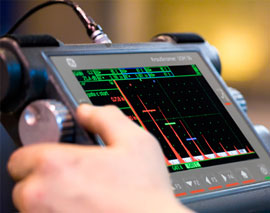
This course offers a high practical content and relevant theoretical background to enable students to achieve a basic understanding of ultrasonic inspection.
Candidates on completion of the course will be able to calibrate a flaw detector with both compression and shear wave probes, record accurate thickness measurements and locate and size laminations in steel plate. In addition students will be able to select the correct compression/shear wave probes for the examination of welded butt joints, locate and size defects and finally produce acceptable reports.
If attempting an ASNT examination the requirements of your company's written practice must be met.
A 5 day course for those with little or no knowledge or experience of ultrasonic techniques
A course for those who already have a basic understanding of the techniques of ultrasonic inspection and want intensive instruction to improve their knowledge and increase their experience. The course is suitable for candidates who are wishing to progress towards any of the examination qualifications. The course has a high practical content; all equipment is provided.
An ideal course for candidates wishing to improve their skills in the practical use of ultrasonic test methods on weldments. This course provides the option of single or multiple days and provides a very flexible option for candidates undertaking ultrasonic training covering both welds and/or wrought products.
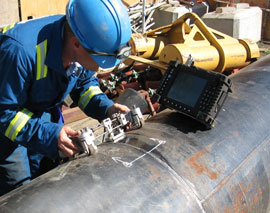
This course provides detailed instructions on the inspection of Ferritic welds / castings/ wrought products by the use of Phased Array Ultrasonic testing. This course is only suitable for holders of current, valid UT certification, approved and accepted by ASNT.
This course is ASNT recognised and provides excellent preparation for the level 2 examinations. It meets in full the training hour requirements as specified by the relevant ASNT documentation.
The course is 12 days long with a 2 day examination after completion.
If attempting an ASNT examination the requirements of your company's written practice must be met.
This course provides detailed theoretical and practical information on all the commonly encountered magnetic particle testing techniques. Candidates will have the opportunity to use a large variety of equipment on welds, castings and wrought products. This course is suitable for beginners and personnel with an existing NDT knowledge. This course is ASNT recognised and provides excellent preparation for Level 1 and 2 examinations. It meets, in full, the training hour requirements as specified by the relevant ASNT documentation.
If attempting an ASNT examination the requirements of your company's written practice must be met.
This course provides detailed theoretical and practical information on all the commonly encountered penetrant testing techniques. Candidates will have the opportunity to use the various techniques on welds, castings and wrought products.
This course is suitable for beginners and personnel with an existing NDT knowledge. This course is ASNT recognised and provides excellent preparation for Level 1 and 2 examinations. It meets, in full, the training hour requirements as specified by the relevant ASNT documentation.
If attempting an ASNT examination the requirements of your company's written practice must be met.
This course provides detailed information on inspection of welds utilising the Eddy Current Testing method, incorporating the latest equipment.
This course is suitable for beginners and personnel with an existing NDT knowledge. This course is ASNT approved and provides excellent preparation for the level 1 examination as specified by the relevant ASNT documentation.
These courses have been designed to provide a full appreciation of the methods and practices of visual testing. A high theory and practical content is offered within these courses in preparation for either ASNT Level 1 or ASNT Level 2 examinations. The courses meet the relevant training hour requirements as specified in the relevant ASNT document.
The Level 1 course consists of the first two days of the 5 day course programme.
This course is intended for personnel with experience in welding inspection, welder training or welding supervision, who are wishing to consider a formal inspection certification route. The course content highlights the key theory areas to be covered and also provides a practical element.
We strongly advise that all candidates take the 5 day course option and allow at least 4 days revision time before attempting the available Weld Inspector examination options. Whilst any candidate can attend this course, examination criteria may exist in terms of experience and we strongly recommend that prospective candidates read in full the ASNT relevant documentation. *This course is also ideal to support the mature candidate route into CSWIP
Welding Inspector - Level 3This course is aimed at experienced welding inspectors who hold approved weld inspector status in an appropriate certifying scheme i.e ASNT or equivalent. The course is designed to review, reinforce and develop the additional subject required for the Weld Inspector Level 2 approval.
This course is intended for personnel with or without experience in welding inspection. It is preferable, but not essential, for applicants to be experienced in the welding, engineering or pipe/pipeline industry.
In addition to general theory, the course analyses the contents of relevant standards including British Gas TransCo specifications applicable to pipeline welding.
There is only one grade of Pipeline Welding Inspector. The Back-end Welding Inspector approval is now obsolete. The current BGAS-CSWIP Pipeline Welding Inspector approval has replaced the Front-end Welding Inspector approval.
Piping study often referred as ‘half science & half art’. Art part includes visualization and creativity, while Science part includes following certain established norms. And both these parts involve lot of dedication, risk taking ability and discipline. The Piping industry is expected to experience considerable change and varying growth rates in the present economy.
This course is intended for personnel with or without experience in welding inspection. It is preferable, but not essential, for applicants to be experienced in the welding, engineering or pipe/pipeline industry.
In addition to general theory, the course analyses the contents of relevant standards including British Gas TransCo specifications applicable to pipeline welding.
There is only one grade of Pipeline Welding Inspector. The Back-end Welding Inspector approval is now obsolete. The current BGAS-CSWIP Pipeline Welding Inspector approval has replaced the Front-end Welding Inspector approval.